
PHYSICAL AND CHEMICAL CHANGES
Notes and NCERT SOLUTIONS
11/2/20241 min read
Chemical Change
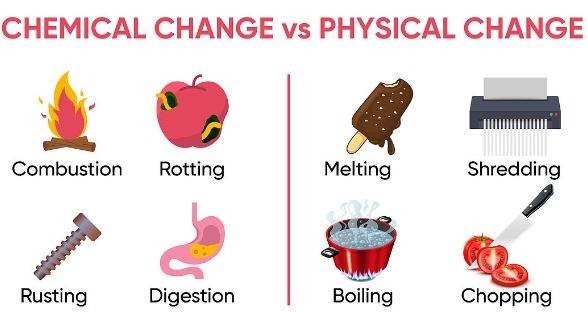
A chemical change occurs when a substance transforms into one or more new substances with different properties. This type of change involves a chemical reaction, and it is usually not reversible by simple physical means. Indicators of a chemical change include:
Color Change: A change in color indicates a new substance may have formed.
Gas Production: Bubbling or fizzing can show that a gas is released.
Temperature Change: The reaction may release or absorb heat, leading to temperature changes.
Formation of a Precipitate: A solid may form when two liquids are mixed.
Examples:
Burning wood (combustion)
Rusting of iron
Baking a cake
Physical Change
A physical change involves a change in the physical properties of a substance without altering its chemical composition. These changes can often be reversed. Indicators of a physical change include:
Change in State: Solid, liquid, or gas states may change (e.g., melting ice).
Change in Size or Shape: Cutting, folding, or breaking a substance.
Dissolving: Mixing a substance in a solvent (e.g., salt in water).
Examples:
Melting ice
Boiling water
Chopping vegetables
· Rusting of Iron
Rusting of iron is a chemical change that occurs when iron is exposed to moist air and water, causing a brown, flaky substance to form on the iron:
· Explanation
Iron molecules react with oxygen molecules to form iron oxide, a new substance. This process is an example of corrosion, which is a chemical change that occurs when metals come into contact with an electrolyte.
· Chemical equation
The chemical equation for rusting is Fe (s) + O2 (g) + H2O (l) → Fe2O3.xH2O (s).
· Prevention
To prevent rusting, you can coat the iron with oil or grease, which forms a protective layer that prevents moisture from interfering with the iron.
· Galvanization
The process of depositing a protective layer of zinc on steel or iron is called galvanization.
It is a method used to prevent corrosion.
Example of galvanization
To avoid rusting, the iron pipes that carry water in our homes are galvanized.
Stainless Steel
Stainless steel is made by mixing iron with carbon and metals like chromium, nickel and manganese. It does not rust.