Chapter 2 – Nutrition in Animals
10/28/20244 min read
Nutrition in Animals
Digestion in the Humans
The human digestive system consists of the alimentary canal and secretory glands. It consists of the (i) buccal cavity, (ii) oesophagus, (iii) stomach, (iv) small intestine, (v) large intestine ending in rectum and (vi) anus.
I Buccal Cavity
The buccal cavity is more commonly known as the mouth, and it is the beginning of the digestive system for humans.
It consists of the tongue and teeth.
Teeth: Helps in chewing food and breaking down food into smaller particles.
Tongue: Fleshy muscular organ attached at the back to the floor of the buccal cavity.
Tongue
It is a muscular organ, fleshy in nature, attached to the back of the base of the buccal cavity.
It helps in mixing saliva with food while chewing and aids in swallowing.
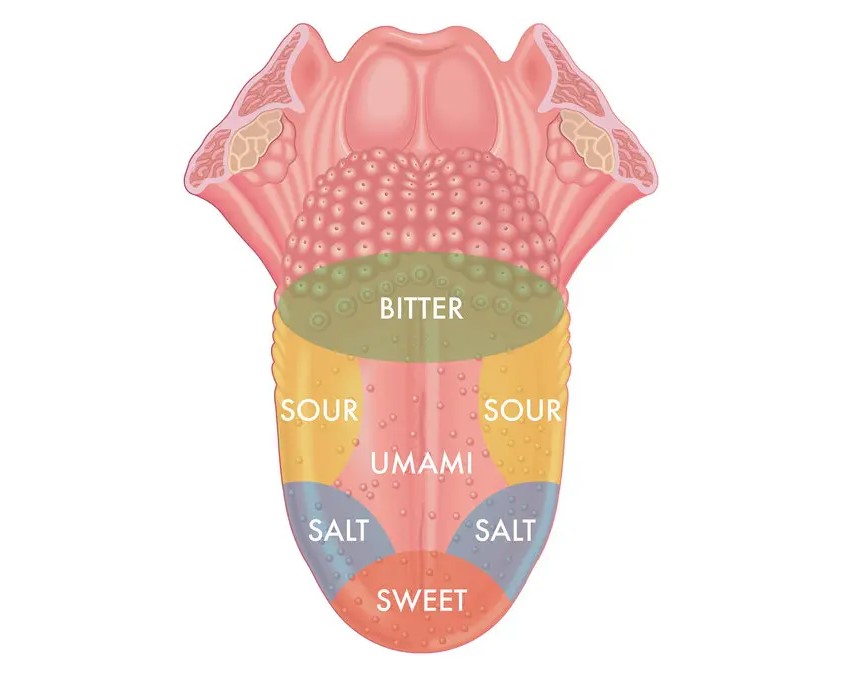
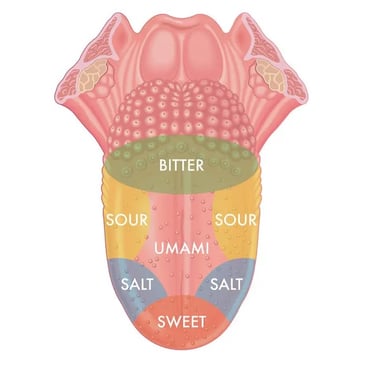
The tongue possesses taste buds that help us recognise different tastes.
II Oesophagus or food pipe
The food that is swallowed passes into the oesophagus.
It is a muscular tube, about 25 cm long, with a sphincter (valve/opening) at each end.
Its function is to transport food and fluid, after being swallowed, from the mouth to the stomach.
Food is propelled down as there is movement through the walls of the food pipe.
III Stomach
It is a thick-walled bag-like structure.
It obtains food from the food pipe and opens into the small intestine towards the other opening.
The inner lining of the stomach produces mucus, hydrochloric acid (HCl) and other digestive juices.
Food is churned into a semi-solid mass in the stomach.
Enzymes present in gastric juice disintegrate the food.
Hydrochloric acid helps in partial digestion of proteins and also kills harmful bacteria.
IV Small Intestine
This is a highly coiled organ of 7.5 metres in length.
It receives the secretion from the liver and pancreas.
Complete digestion and absorption of food take place in the small intestine.
Villi
The inner walls of the intestine have finger-like outgrowth called villi.
Villi increase the surface area for the absorption of food.
Each villus has a small network of blood vessels.
Absorbed food by villi is transferred to the body via blood vessels.
V Large Intestine
It is wider and shorter than the small intestine.
It is 1.5m in length.
Absorption of water and salt from undigested food occurs in the large intestine.
The remaining waste matter is passed out through the rectum.
From time to time, faecal matter is removed through the anus (egestion).
VI Anus
The anus is the opening at the end of the human digestive tract.
The removal of faecal matter from the large intestine occurs through the anus and this process is called egestion.
Taste Sensations
The tongue detects five primary taste sensations:
Sweet: Often associated with sugars and some amino acids.
Sour: Typically linked to acidity (e.g., citric acid).
Salty: Primarily detected through sodium ions.
Bitter: Associated with various compounds, often toxic; important for survival.
Umami: The taste of amino acids, particularly glutamate, often found in savory foods.
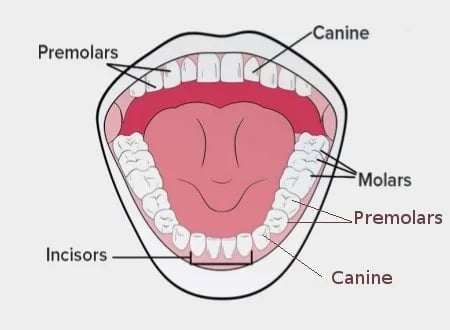
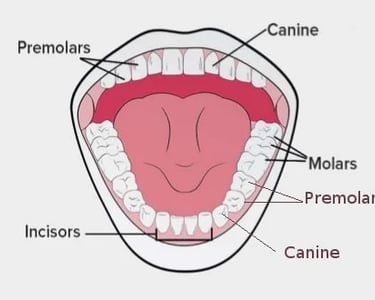
Humans have two sets of teeth:
Primary teeth
Primary teeth are also known as deciduous teeth, milk teeth, baby teeth or temporary teeth. Primary teeth start to form during the embryo phase and erupt during infancy (from 6 months to 3 years).
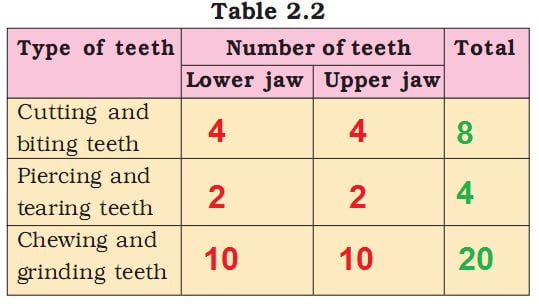
Normally, there are 20 primary teeth, 10 on each dental arch: 4 incisors (2 central incisors and 2 lateral incisors), 2 canines and 4 molars.
Permanent teeth
Permanent teeth (or adult teeth) are the second set of teeth and normally consist of 32 teeth. The first permanent teeth appear around the age of 6.
Up to the age of thirteen years, twenty-eight of the thirty-two permanent teeth will appear. The four last permanent teeth, the third molars or the wisdom teeth, usually appear between the ages of 17 and 25 years.
Ingestion
The process of taking food into the body is called ingestion
Digestion
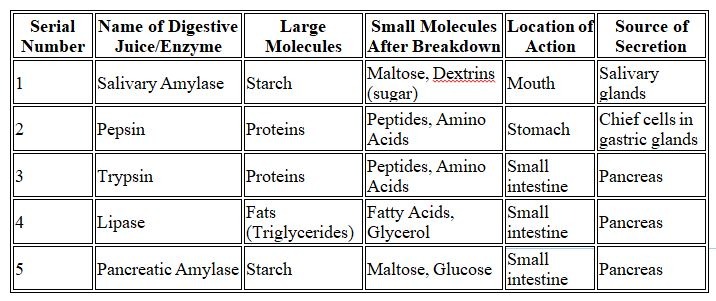
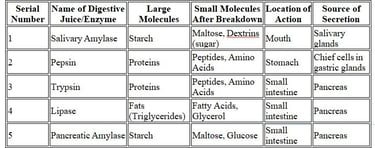
The breakdown of complex components of food into simpler substances is called digestion. Partial digestion takes place in the stomach and complete digestion takes place in the intestine.
Absorption
The small intestine absorbs digested food molecules into the blood. The small intestine has a large surface area for absorption due to villi and microvilli.
Assimilation
The substances that are absorbed are transported through blood vessels to various organs of the body where it is utilized to build complex substances like proteins essential for the body. This is called assimilation.
Digestion in Grass-Eating Animals
The digestive system in grass-eating animals is different from that of humans.
These animals chew continuously, even when they are not eating.
They swallow the grass very fast and store it in a chamber called Rumen.
In the rumen, the bacteria partially digest the food, and now it is called as cud.
Later, the cud reverts to the mouth, and the animal chews it again slowly.
This phenomenon is referred to as rumination, and the animals are called ruminants.
They also have a very long small intestine, which helps in the complete digestion of cellulose, the main component of grass.
Feeding and Digestion in Amoeba
Amoeba
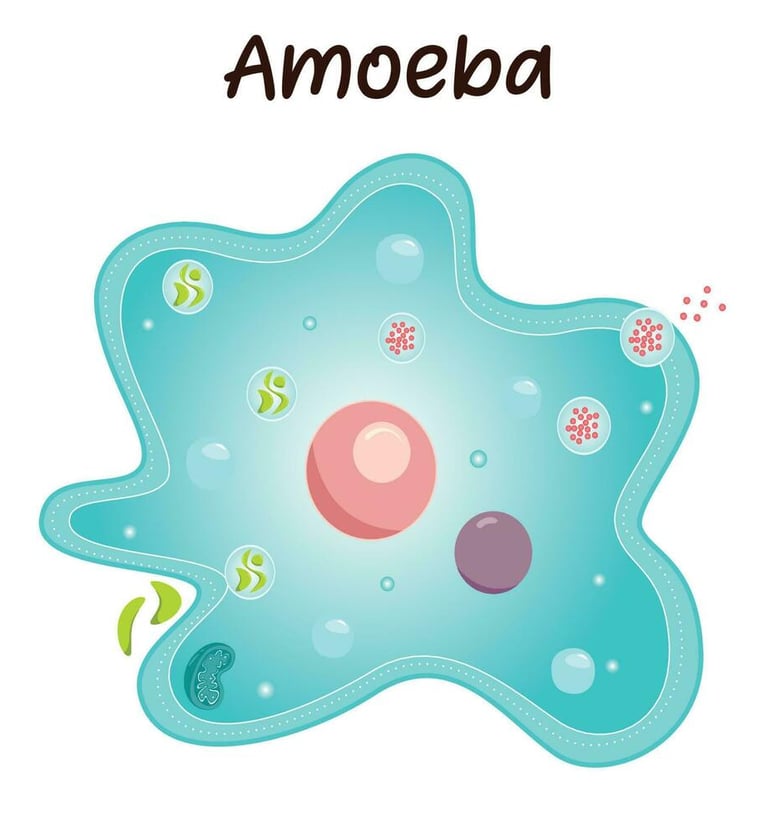
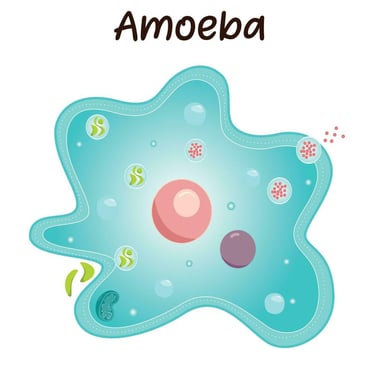
Amoeba is a single-celled organism, microscopic in nature, found in pond water.
Amoeba regularly changes its shape and position.
Process of Digestion in Amoeba
Amoeba captures the food particles with the help of pseudopodia. The process is called phagocytosis.
A food vacuole is thus created with the food material inside.
Digestive juices are produced into the food vacuole when it is moving through the cytoplasm.
They act on the food and disintegrate it into simpler substances, and the digested food is then absorbed.
Finally, the food vacuole opens to the outside and undigested food is released into the surrounding water.
Cud
Partially digested food, returned from the rumen into the mouth, for further chewing is called cud.
Rumination
Rumination is the process by which the cattle regurgitate previously consumed feed and masticate it a second time.
Tooth Decay
Bacteria present in the mouth break down the sugars present from the leftover food and release acid.
These acids gradually damage the teeth and result in tooth decay.